The Gloup Disaster Memorial is a statue of a woman looking out to sea with a child held in her arms. On the 20th July 1881 this depicted the scene all along the coast at Gloup, and other coastal communities in Shetland. Women waited, and hoped that their husbands and children would return. But sadly many did not. The Gloup Disaster was perhaps the beginning of the end for the Haaf Fishing. This could have been the point where it was realised that going so far to sea in relatively small boats, was just too big a risk, and cost in terms of lives lost.
The word ‘haaf’ is derived from the Norse word ‘hav’, meaning open sea. This was certainly the case with the Shetland ‘Far Haaf’ fishing. The haaf fishing was carried out from the mid 18th century, until the end of the 19th century, and the crew of a Sixareen could be as much as 50 miles from home when they set their fishing lines. The Sixareen was an open 6 oared boat with a square sail. For stability the boats set out on fishing trips with a large amount of stone ballast on board, which was dumped as fish was caught to replace it.
The sixareen crews, forced by the fear and burden of debt, were under constant pressure from the Lairds to fish, and often this pressure meant that a crew would take a chance and stay at sea beyond the point where the weather conditions dictated that it was unsafe. The Haaf season traditionally started on the 12th May, although the crews would have spent some time beforehand tarring the boats, preparing their equipment, and ensuring that the lodges they would spend their time ashore in, were fit for habitation. Weather permitting a crew made 2 trips each week, Monday to Wednesday, and Thursday to Saturday, in which time the crew, baited and set up to 100 lines for Ling, Tusk, and Cod.
The day of 20th July 1881, started as what is referred to as a "day atween wadders", there had been strong winds for days and the boats had been kept ashore, but the morning of the 20th dawned clear with light winds, and although there was still a heavy sea running, the men were keen to get to sea. Their departure was delayed for the funeral of Jeemie Henry, skipper of the sixareen "Elizabeth", who had died of "Bool Cramp", the name given then to acute apendicitis. Going over 40 miles to the fishing grounds, using simple landmarks for navigation, the boats had no idea of what was to happen. The crews were happy that the bad weather was over. If only they could have had the benefit of modern forecasts. A fast moving depression which had formed to the west near Iceland rushed in with Hurricane force winds. The crews were taken by surprise, and made every effort to reach shore, but for some crews that was impossible. Some of the boats which made shore were to report seeing boats overturned, and with no sign of life, there was nothing they could do, they had to consider the survival of their own crew. The heroism of the skippers who managed to reach shore in that storm should never be forgotten.
Only the bodies of seven men were found, 36 of the men were from Gloup. The 58 drowned haaf fishermen left behind 34 widows and 85 orphans.
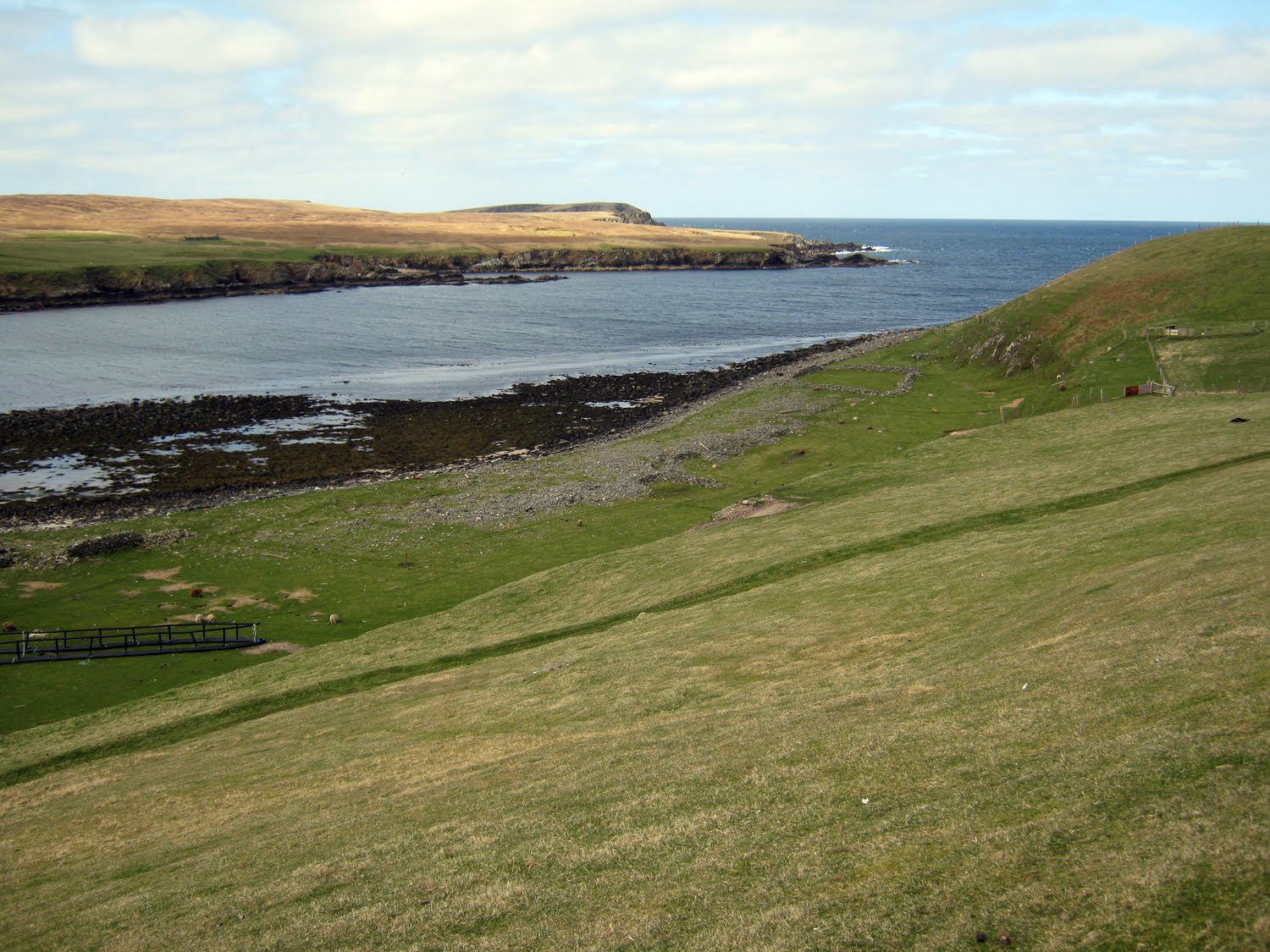
The landing place at Gloup Voe.
Looking out of Gloup Voe.
Inner Gloup Voe.




.jpg)


